
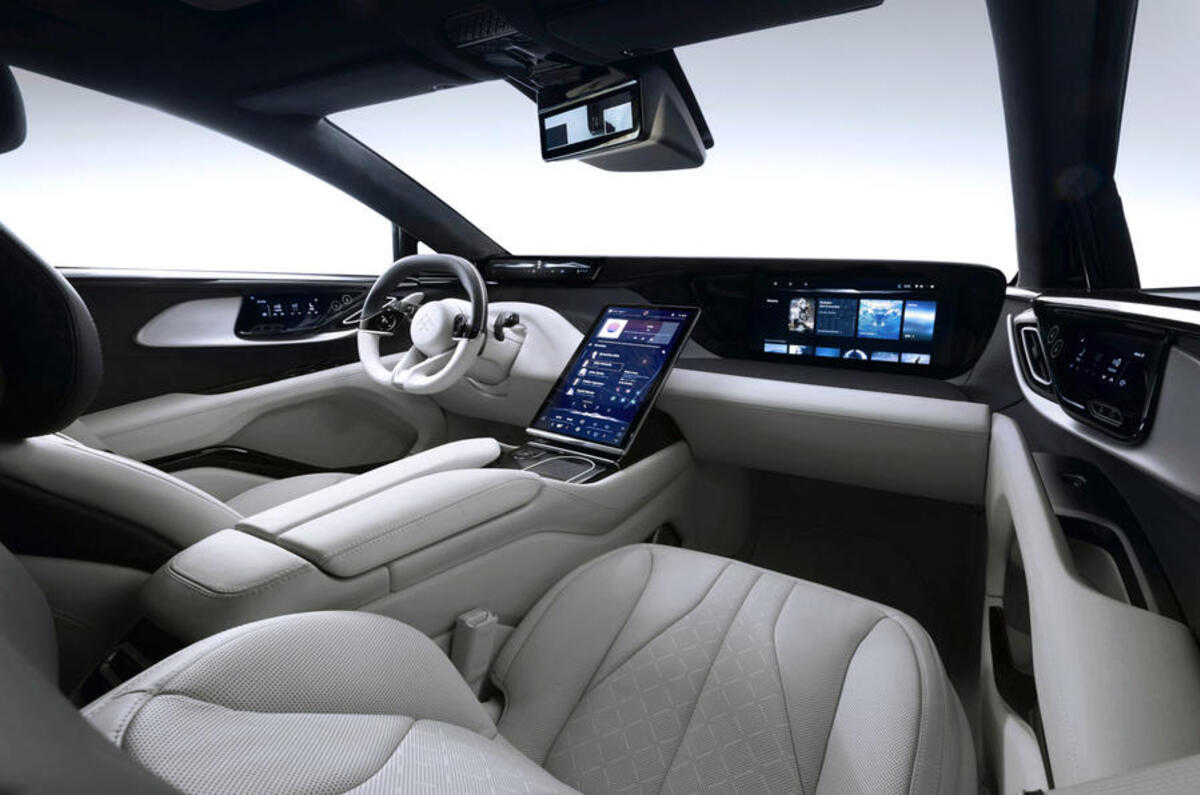
I say start-up, Faraday Future has been around since 2014, but this week we saw the interior of its FF91, said to go on sale next year. It’s the FF91’s insides that are set to become this ‘third space’, Faraday Future thinks. “The smart TV was introduced first in 2013 and changed the way we accessed digital content at home,” it says. “Faraday Future’s mission is to change the concept of digital life when we’re in our vehicles.”
To that end, the car gets 11 screens inside, of various sizes. The 10 smaller screens include digital instruments and rear-view ‘mirrors’; the biggest is a 27in HD TV built into the roof.
The seats recline to put occupants into the kind of position NASA reckons one naturally goes into during weightlessness, so is meant to be ultra-relaxing. Put me down for a fascinating examination of the smaller surface area inside my eyelids, in that case, but whether I’m snoozing or watching/browsing, there’s one thing I definitely can’t be doing, and that’s driving.
Find an Autocar car review
Driven this week
Vauxhall Corsa 2020 road test review - tracking front
31 JANUARY 2020
CAR REVIEW
Vauxhall Corsa
Do PSA Group mechanicals herald a new era of success for Vauxhall's...
Mini Electric 2020 first drive review - hero front
28 JANUARY 2020
FIRST DRIVE
Mini Electric 2020 review
Mini’s new electric hatchback won’t break records on range or usability but...
Peugeot 208 GT Line 2020 UK first drive review - hero front
28 JANUARY 2020
FIRST DRIVE
Peugeot 208 GT Line Puretech 130 2020 UK review
Eye-catching supermini arrives in the UK in a range-topping form. Can it...
Article continues below advertisement
Which means one of two things. Either I’m a passenger, in which case the 27in HD screen needs to be invisible to the person who’s doing the driving. Or nobody is driving, in which case the car is driving itself. Which won’t happen next year. Or the year after. Or, depending on the kind of roads involved and the kind of weather and other road users, for who knows how long.
The FF91 isn’t alone in wanting to give its occupants ever more connectivity. Start-ups and established car makers are all at this idea of bringing ever-increasing communication to their vehicles. More convenience. Making the car more like your home or office.
About which there are two things to remember. First, there aren’t so many separate digital spaces anymore; because thanks to smartphones, tablets or hybrids of these, our entire world is a digital space. Whether we’re in a car, shop, pub, train, home, office, bath or out walking, if we want to be connected, we can be. Apart from that bit on the M40 where the DAB radio signal drops out.
Second, if you’re driving, you can’t do anything other than drive plus talk and listen, which is something car audio or phones have let us do for decades. Ever-increasing connectedness is the mobility provider's theme. But when you’ve got your digital life in the palm of your hand already, it’s hard to see that you need anything more than a stand to put it on.
0 Comments
Enregistrer un commentaire